


Utility bills have risen more than 40% in recent years. Are you paying more than necessary to heat and cool your home? An energy assessment is one of the SMARTEST INVESTMENTS you can make for your home. Our motto is simple… Make Energy (In)Efficiency Visible!
As a Pittsburgh-based nonprofit dedicated to improving residential housing performance, we provide independent home energy consulting with no contractor sales pressure. You will receive personalized service, expert guidance, and trustworthy recommendations tailored to your home’s unique needs.
 (412)-465-0197, email us info@eeepgh.org, or fill to see if this could benefit you.
Our wholistic checkup of your home, priced at $400, includes:
- Blower door testing to measure air leakage
- Infrared imaging to identify hidden energy loss
- Written and illustrated report for best home improvement decisions
- Opportunities for rebates, incentives, and low-cost loans
- Home Energy Score benchmarking
We also offer Advisory and Follow-up Services (priced at $60/hr):
- Unbiased guidance on contractor quotes
- Research and recommendations for efficient equipment
- Quality control and verification of contractor’s work
(412)-465-0197, email us info@eeepgh.org, or fill to see if this could benefit you.
AVOID EXPENSIVE MISTAKES
Before spending thousands on insulation, windows, or HVAC equipment, including heat pumps, find out what your home actually needs. The wrong upgrade can be costly; the right one can improve comfort and lower energy bills for years.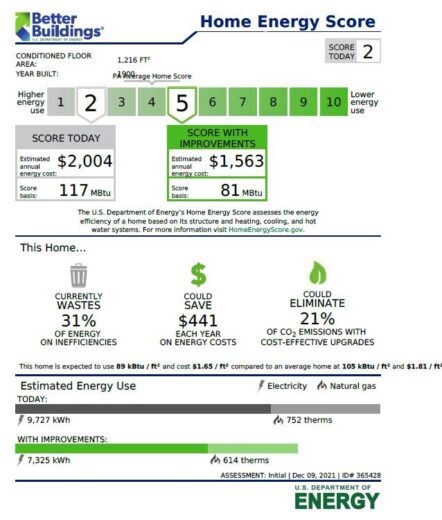
Like a miles-per-gallon rating for a car, the Home Energy Score is based on a standard assessment and modeling to easily compare energy use in homes.

The Home Energy Score tool also provides recommendations for cost effective energy efficiency improvements.

Blower door measures air leakage from the house. Air leaks, or drafts, can be responsible for as much as 30% of energy loss.

Add Subheading Text
Digital gauge of the blower door shows air leakage in cubic feet per minute at a pressure of 50 Pascals.

Thermal imaging camera is used to find areas without insulation in the walls or ceilings.

Measurements of insulation, in attics and crawl spaces, are entered into Home Energy Score modeling software to determine the score.
Apart from renovations, replacing your heating and cooling system is one of the largest investments you will make in your home. A well-planned project can improve comfort, reduce utility bills, lower environmental impact, and provide reliable service for many years. A poor decision, however, can leave you with uncomfortable rooms, high operating costs, and equipment that never performs as expected.
Here are some important considerations before signing a contract.
Plan Ahead—Don’t Wait for an Emergency
If your existing system is still operating, now is the best time to begin planning.
Replacing equipment during an emergency often limits your choices and may force you to accept whatever equipment is immediately available. Planning ahead gives you time to compare options, evaluate contractors, and choose the solution that best fits your goals.
________________________________________
Improve the House Before Replacing the Equipment One of the biggest mistakes homeowners make is replacing HVAC equipment before improving the home’s energy efficiency. Air sealing and insulation often reduce the heating and cooling needs enough to allow installation of smaller equipment that costs less to purchase and to operate, runs more efficiently while providing better comfort, and lasts longer because it cycles less.
________________________________________
Decide What Matters Most Every homeowner has different priorities. Knowing your priorities helps determine which solution is the best fit. Did you know that a heat pumps can heat a home at efficiencies of well over 400 percent in cool weather? For comparison, conventional heating systems that run on gas, oil, or propane have efficiencies between 80-97 percent. Ask yourself:
________________________________________
New Equipment Does Not Automatically Solve Comfort Problems If some rooms have always been uncomfortable, simply replacing the furnace or air conditioner is unlikely to fix the problem. Comfort depends on many factors, including:
________________________________________
Proper Equipment Sizing Is Essential Bigger is not better. Oversized equipment cycles on and off more frequently, reducing efficiency, comfort, humidity control, and equipment life. Undersized equipment may struggle during extreme weather. The correct equipment size is determined using an ACCA Manual J heating and cooling load calculation. A qualified HVAC contractor should perform this calculation before recommending equipment. E3 also provides independent Manual J calculations to help homeowners evaluate contractor proposals. Real-world example: After air sealing and insulating a small 721 s.f. home in Allentown as part of the renovation, the calculated heating load dropped from 42,300 BTU/h to 17,800 BTU/h. That reduction meant a smaller heat pump could meet the home’s needs, lowering both equipment cost and operating cost while improving efficiency.
________________________________________
Good HVAC Design Involves More Than Manual J The Air Conditioning Contractors of America (ACCA) recommends four design procedures:
________________________________________
Compare Systems—Not Just Prices Even after the correct equipment size has been determined, there are many decisions to make. Questions include:
________________________________________
Don’t Overlook the Thermostat Today’s thermostats are remarkably sophisticated but also vary a lot between manufacturers. Their factory settings and available adjustments can dramatically affect utility cost and energy consumption. This is especially important for homes with heat pumps and electric resistance backup heat, dual fuel systems with a heat pump and a furnace, and variable-speed equipment. We recommend reviewing thermostat options carefully as part of the proposal and also not assuming the factory defaults are appropriate.
________________________________________
Indoor Air Quality Matters Too Your HVAC system is also responsible for filtering the air you breathe. The choices of filter, filter thickness, duct design and blower settings affect both indoor air quality and energy consumption. Consider what your system could do during periods of poor outdoor air quality, such as wildfire smoke events that are not as rare as they used to be in our region. A smart decision during HVAC upgrade can enable and improve filtration while maintaining good airflow and equipment efficiency.
________________________________________
How E3 Can Help As an independent nonprofit, E3 does not sell HVAC equipment. Instead, we help homeowners make informed decisions by providing:
call (412)-465-0197 or email us info@eeepgh.org to reach us.
________________________________________
Improve the House Before Replacing the Equipment One of the biggest mistakes homeowners make is replacing HVAC equipment before improving the home’s energy efficiency. Air sealing and insulation often reduce the heating and cooling needs enough to allow installation of smaller equipment that costs less to purchase and to operate, runs more efficiently while providing better comfort, and lasts longer because it cycles less.
________________________________________
Decide What Matters Most Every homeowner has different priorities. Knowing your priorities helps determine which solution is the best fit. Did you know that a heat pumps can heat a home at efficiencies of well over 400 percent in cool weather? For comparison, conventional heating systems that run on gas, oil, or propane have efficiencies between 80-97 percent. Ask yourself:
- Is comfort my biggest concern?
- Are some rooms always too hot or too cold?
- Do I want better summer cooling?
- Is lowering my utility bill most important?
- Do I want to reduce my home’s carbon footprint?
- Am I willing to pay more to achieve lower environmental impact?
________________________________________
New Equipment Does Not Automatically Solve Comfort Problems If some rooms have always been uncomfortable, simply replacing the furnace or air conditioner is unlikely to fix the problem. Comfort depends on many factors, including:
- duct sizing
- duct leakage
- return-air design
- airflow balancing
- room-by-room heating and cooling requirements
- commissioning after installation
________________________________________
Proper Equipment Sizing Is Essential Bigger is not better. Oversized equipment cycles on and off more frequently, reducing efficiency, comfort, humidity control, and equipment life. Undersized equipment may struggle during extreme weather. The correct equipment size is determined using an ACCA Manual J heating and cooling load calculation. A qualified HVAC contractor should perform this calculation before recommending equipment. E3 also provides independent Manual J calculations to help homeowners evaluate contractor proposals. Real-world example: After air sealing and insulating a small 721 s.f. home in Allentown as part of the renovation, the calculated heating load dropped from 42,300 BTU/h to 17,800 BTU/h. That reduction meant a smaller heat pump could meet the home’s needs, lowering both equipment cost and operating cost while improving efficiency.
________________________________________
Good HVAC Design Involves More Than Manual J The Air Conditioning Contractors of America (ACCA) recommends four design procedures:
- Manual J – determines the home’s heating and cooling loads.
- Manual S – selects equipment that matches those loads.
- Manual D – designs the duct system.
- Manual T – selects supply registers and return grilles for proper air distribution.
________________________________________
Compare Systems—Not Just Prices Even after the correct equipment size has been determined, there are many decisions to make. Questions include:
- Heat pump or furnace?
- Dual-fuel or all-electric?
- Single-stage, two-stage, or variable-speed equipment?
- Ducted or ductless?
- Which efficiency level offers the best value?
- Which manufacturer provides the features that matter most?
________________________________________
Don’t Overlook the Thermostat Today’s thermostats are remarkably sophisticated but also vary a lot between manufacturers. Their factory settings and available adjustments can dramatically affect utility cost and energy consumption. This is especially important for homes with heat pumps and electric resistance backup heat, dual fuel systems with a heat pump and a furnace, and variable-speed equipment. We recommend reviewing thermostat options carefully as part of the proposal and also not assuming the factory defaults are appropriate.
________________________________________
Indoor Air Quality Matters Too Your HVAC system is also responsible for filtering the air you breathe. The choices of filter, filter thickness, duct design and blower settings affect both indoor air quality and energy consumption. Consider what your system could do during periods of poor outdoor air quality, such as wildfire smoke events that are not as rare as they used to be in our region. A smart decision during HVAC upgrade can enable and improve filtration while maintaining good airflow and equipment efficiency.
________________________________________
How E3 Can Help As an independent nonprofit, E3 does not sell HVAC equipment. Instead, we help homeowners make informed decisions by providing:
- Independent Manual J heating and cooling load calculations
- Review of contractor proposals
- Equipment comparisons
- Heat pump guidance
- Building science recommendations
- Blower door testing
- Duct leakage evaluation
- Home Energy Scores
- Building performance verification
call
(412)-465-0197 or email us info@eeepgh.org to reach us.